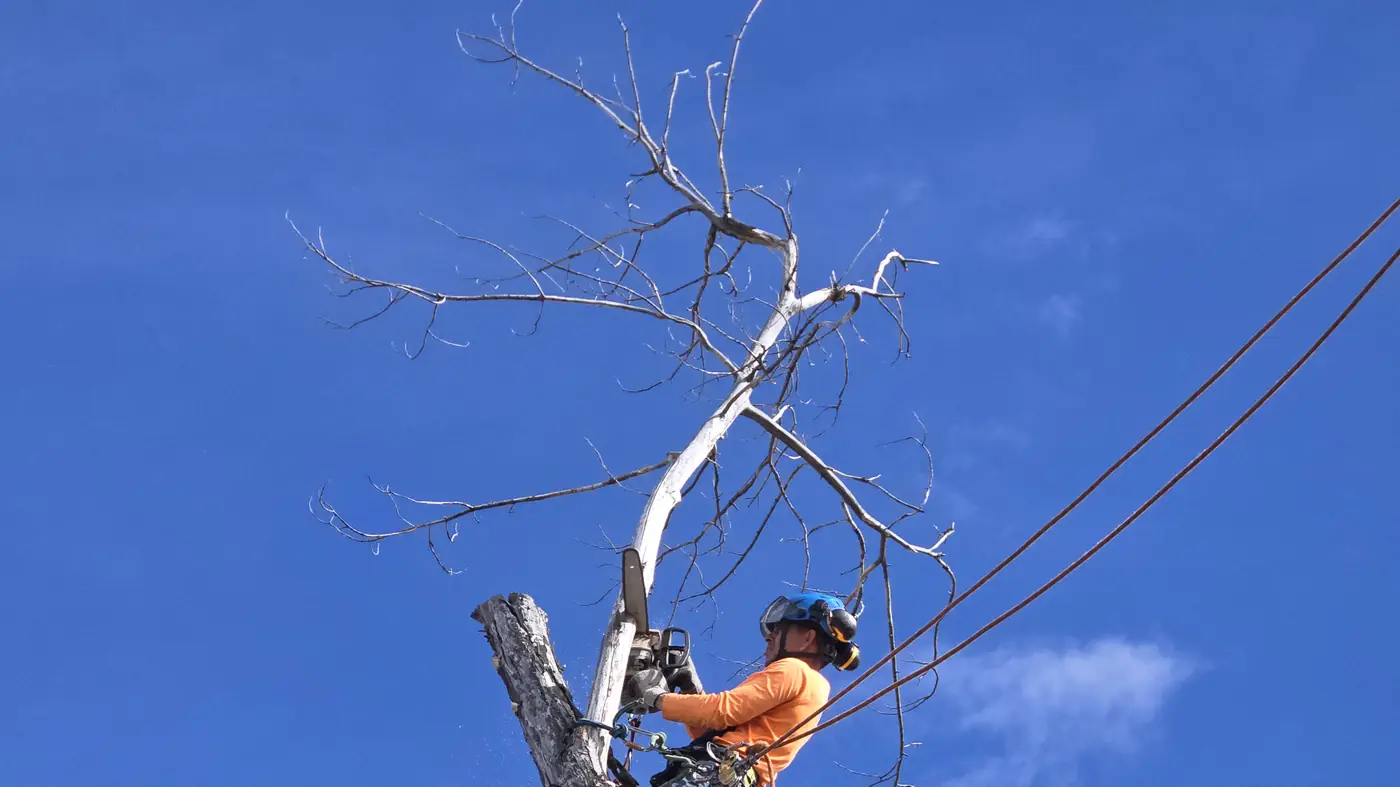
A dead tree does not stay standing forever. In the north Denver metro, where spring wet snow storms can drop heavy, wet loads on already weakened wood, a dead tree near your house or driveway is a real liability. The wood gets brittle faster than most homeowners expect, and once it starts to fall, there is no predicting exactly where it goes.
Arbol De Fuego Services removes dead and hazardous trees in Northglenn and across Adams County. Call (720) 210-3718 for a free estimate.
How to Tell If a Tree Is Dead or Dying
You do not need to be an arborist to spot the major warning signs. Here is what to look for:
- Bare branches in season. If a tree that should have leaves does not, or if large sections of the canopy are bare while the rest leafs out, the tree or major sections of it are likely dead.
- Peeling or falling bark. Bark that is slipping off in sheets, especially with no green layer underneath, signals the tree is no longer alive in that section.
- D shaped holes in the bark. On ash trees specifically, these are the exit holes left by emerald ash borer, which has been confirmed in Westminster, Thornton, and Broomfield. A heavily infested ash tree dies within a few years.
- Fungal growth at the base. Mushrooms or shelf fungi growing at the base or on the trunk mean decay is happening inside the wood, which compromises structural integrity.
- Soft or hollow wood. If you can push a screwdriver or pocketknife into the wood at the base more than an inch without much resistance, the inside of the tree may already be compromised.
- Cracks in the trunk. Vertical cracks or splits in the main trunk, especially ones that have opened up recently, mean the tree is under structural stress.
- A sudden lean. A tree that has started leaning, especially if roots are heaving on one side, may be losing its anchor in the ground.
If you see two or more of these on the same tree, call us. We will come look at it and give you a straight answer.
Why Timing Matters
Dead and hazardous trees become harder and more expensive to remove as they deteriorate further. The wood becomes more brittle, which makes controlled removal more difficult. The roots decay, which affects stability. Waiting until after a tree has already come down, on a fence, a car, or a structure, costs far more and happens at the worst possible time.
Northglenn gets significant wet snow events in March, April, and even May. A dead cottonwood or elm carrying a heavy snow load is a common cause of property damage in Adams County. If a tree has already come down or dropped a limb on the house, see our emergency and storm services.
Our Process
- Free estimate. We assess the tree in person and tell you what we see. If the tree is dead or structurally compromised, we explain the risk and give you a written quote for removal.
- Planning the removal. Dead trees require extra care because the wood does not behave predictably. We plan the drop zone carefully and use rigging when needed.
- Removal. We work top down on compromised trees whenever the site allows, removing limbs and trunk sections in a controlled sequence.
- Cleanup. All material is chipped or hauled. We clean up the site before we leave.
- Stump grinding. Available as an add on. Details here.
What It Costs
A dead tree is usually priced like a live tree of the same size and location, with one difference: brittle wood that cannot be climbed safely may need a bucket truck or crane, which adds to the quote. That is exactly why it pays to call early. A declining tree that still holds a climber is a simpler, cheaper job than one that has been dead for three winters. We give you a written number after we see it, before any work starts.
Ash Trees and Emerald Ash Borer
Emerald ash borer has moved into the north Denver metro. If you have an ash tree and it has started dropping leaves early, showing a sparse canopy, or showing the characteristic D shaped bark holes, it may be infested. Once infestation reaches a certain point, the tree cannot be saved and removal is the only option. We handle ash removals regularly in Northglenn and the surrounding area, and we can refer you to a licensed applicator if the tree is still worth treating.